
Discover our new Kick-Ass Systems
High-End PC guide 2026
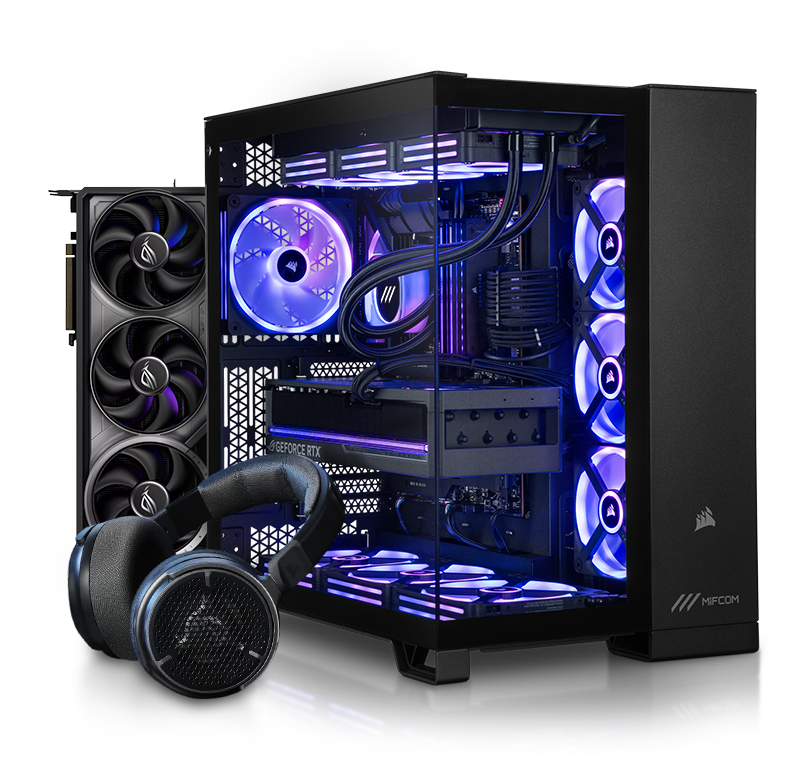 | High-End PC Systems –
If you’re a professional PC user, a hardcore gamer, or an overclocker who enjoys pushing limits and getting the most out of high-end hardware, the MIFCOM High-End PC series is the perfect choice for you.
A high-end gaming PC is characterized by extreme computing power, made possible by the most powerful processors combined with the fastest graphics cards. Thanks to ultimate 3D performance, the latest games are a real blast on a high-end gaming PC, even at the highest detail levels and resolutions, and across multiple monitors.
However, a high-end PC isn’t just essential for gamers seeking top performance and the best results. Professional applications such as rendering, HD video editing, or AI simulation often require even more resources than gaming, and in some cases even a multi-GPU system (NVLink). In these areas, using a high-end PC delivers a noticeable performance boost compared to a standard computer. |
|
High-End PC Systems –
If you’re a professional PC user, a hardcore gamer, or an overclocker who enjoys pushing limits and getting the most out of high-end hardware, the MIFCOM High-End PC series is the perfect choice for you.
A high-end gaming PC is characterized by extreme processing power, made possible by the most powerful processors combined with the fastest graphics cards. Thanks to ultimate 3D performance, the latest games are a real blast on a high-end gaming PC, even at the highest detail levels and resolutions, and across multiple monitors.
However, a high-end PC isn’t just essential for gamers seeking top performance and the best results. Professional applications such as rendering, HD video editing, or AI simulation often require even more resources than gaming, and in some cases even a multi-GPU system (NVLink). In these areas, using a high-end PC delivers a noticeable performance boost compared to a standard computer. |
Tips for building a High-End PC - What you should look for
 | High-End PC Processor
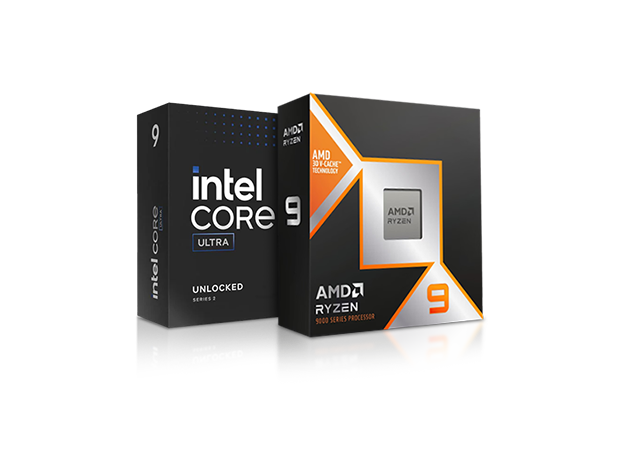
For a high-end PC, only the fastest processors will ensure that your new high-end gaming PC truly lives up to your expectations, even in the most performance-intensive games and applications. After all, the demands on a high-end PC’s processor are significant. Such a machine must not only handle all games at a minimum of 4K resolution, including quality-enhancing features, without issue, but also manage demanding multitasking with multiple CPU-intensive tasks simultaneously while delivering top performance in professional applications like HD video editing or rendering.
Currently, AMD processors from the Ryzen 9000 generation on the AMD AM5 platform are particularly recommended for gamers and creators. Powerful and efficient CPUs with 8 to 16 cores cover all needs. Of particular note, especially for gamers, are X3D processors with a particularly large amount of L3 cache. This noticeably boosts gaming performance. Accordingly, we recommend an AMD Ryzen 7 9800X3D for our high-end PCs. In the current Arrow Lake generation (Intel Core Ultra), Intel impresses above all with high multithreaded performance thanks to up to 24 cores. Intel takes a hybrid approach here, combining powerful performance cores with efficient E-cores, which is a good choice when productivity applications are the priority.
AMD takes this approach even further with its Threadripper processors. Up to 96 cores and 192 threads are possible, with generously equipped motherboards supporting numerous expansion cards. However, gaming performance still falls short of the aforementioned Intel Core or AMD Ryzen processors. |
Tips for building a High-End PC - What you should look for
|
High-End PC Processor
For a high-end PC, only the fastest processors will ensure that your new high-end gaming PC truly lives up to your expectations, even in the most performance-intensive games and applications. After all, the demands on a high-end PC’s processor are significant. Such a machine must not only handle all games at a minimum of 4K resolution, including quality-enhancing features, without issue, but also manage demanding multitasking with multiple CPU-intensive tasks simultaneously while delivering top performance in professional applications like HD video editing or rendering.
Currently, AMD processors from the Ryzen 9000 generation on the AMD AM5 platform are particularly recommended for gamers and creators. Powerful and efficient CPUs with 8 to 16 cores cover all needs. Of particular note, especially for gamers, are X3D processors with a particularly large amount of L3 cache. This noticeably boosts gaming performance. Accordingly, we recommend an AMD Ryzen 7 9800X3D for our high-end PCs. In the current Arrow Lake generation (Intel Core Ultra), Intel impresses above all with high multithreaded performance thanks to up to 24 cores. Intel takes a hybrid approach here, combining powerful performance cores with efficient E-cores, which is a good choice when productivity applications are the priority.
AMD takes this approach even further with its Threadripper processors. Up to 96 cores and 192 threads are possible, with generously equipped motherboards supporting numerous expansion cards. However, gaming performance still falls short of the aforementioned Intel Core or AMD Ryzen processors. |
 | High-end PC graphics card
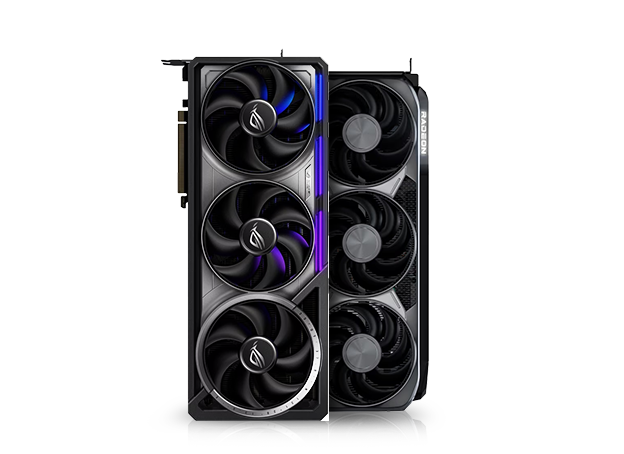
To enable the best possible "state-of-the-art" 3D performance on a high-end PC, high-end graphics cards from the latest NVIDIA GeForce and AMD Radeon generations are required. These are capable of running all current games at WHQD resolution (2560x1440) with maximum settings, including anti-aliasing. The fastest models, such as the NVIDIA GeForce RTX 5080 or GeForce RTX 5090, can even handle resolutions up to 7680x4320 (8K) in some cases without lowering the quality settings, or support multiple WQHD monitors and high-refresh-rate gaming. This is primarily supported by features such as NVIDIA DLSS with Multi-Frame Generation (MFG) or AMD FSR.
In addition to Ultra HD gaming at the highest settings and resolutions, rapid editing of HD videos with GPU acceleration, for example using the Mercury Engine in Adobe Premiere, or complex scientific calculations that leverage GPU computing power are just a few of the other potential applications for a high-end PC equipped with the appropriate graphics card. |
|
High-end PC graphics card
To enable the best possible "state-of-the-art" 3D performance on a high-end PC, high-end graphics cards from the latest NVIDIA GeForce and AMD Radeon generations are required. These are capable of running all current games at WHQD resolution (2560x1440) with maximum settings, including anti-aliasing. The fastest models, such as the NVIDIA GeForce RTX 5080 or GeForce RTX 5090, can even handle resolutions up to 7680x4320 (8K) in some cases without lowering the quality settings, or support multiple WQHD monitors and high-refresh-rate gaming. This is primarily supported by features such as NVIDIA DLSS with Multi-Frame Generation (MFG) or AMD FSR.
In addition to Ultra HD gaming at the highest settings and resolutions, rapid editing of HD videos with GPU acceleration, for example using the Mercury Engine in Adobe Premiere, or complex scientific calculations that leverage GPU computing power are just a few of the other potential applications for a high-end PC equipped with the appropriate graphics card. |
 | High-End PC SSD Drive
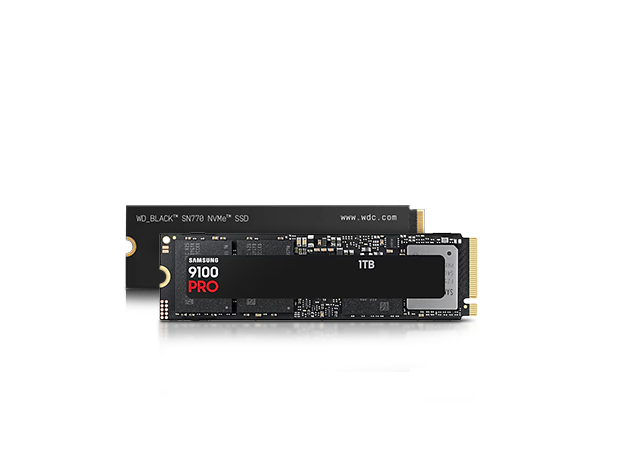
SSD drives are much faster than conventional hard drives. This significantly reduces loading times for the operating system and applications, as well as for opening and saving files, and makes the entire workflow feel smoother. Additionally, there are differences between SATA and NVMe interfaces. While SSDs with SATA technology enable transfer rates of 500 to 600 MB/s, SSDs with NVMe technology, in combination with the PCI Express 5.0 protocol, can achieve transfer rates of up to 15,000 MB/s. Therefore, a fast PCIe SSD with at least a Gen 4 connection therefore is essential! Although storage requirements vary greatly from person to person, we recommend a model with 2 TB of storage capacity as a starting point.
If the speed of a single SSD is no longer sufficient, which can happen in HD video editing when multiple video streams need to be read and written simultaneously, it makes sense to combine multiple SSD drives into a RAID array to further increase data transfer rates. For this purpose, you should use a dedicated RAID controller, known as hardware RAID, since onboard RAID controllers on motherboards typically manage the array via software rather than a separate chip. As a result, they often provide lower performance and security. |
|
High-End PC SSD Drive
SSD drives are much faster than conventional hard drives. This significantly reduces loading times for the operating system and applications, as well as for opening and saving files, and makes the entire workflow feel smoother. Additionally, there are differences between SATA and NVMe interfaces. While SSDs with SATA technology enable transfer rates of 500 to 600 MB/s, SSDs with NVMe technology, in combination with the PCI Express 5.0 protocol, can achieve transfer rates of up to 15,000 MB/s. Therefore, a fast PCIe SSD with at least a Gen 4 connection therefore is essential!
If the speed of a single SSD is no longer sufficient, which can happen in HD video editing when multiple video streams need to be read and written simultaneously, it makes sense to combine multiple SSD drives into a RAID array to further increase data transfer rates. For this purpose, you should use a dedicated RAID controller, known as hardware RAID, since onboard RAID controllers on motherboards typically manage the array via software rather than a separate chip. As a result, they often provide lower performance and security. |
 | High-End PC Memory
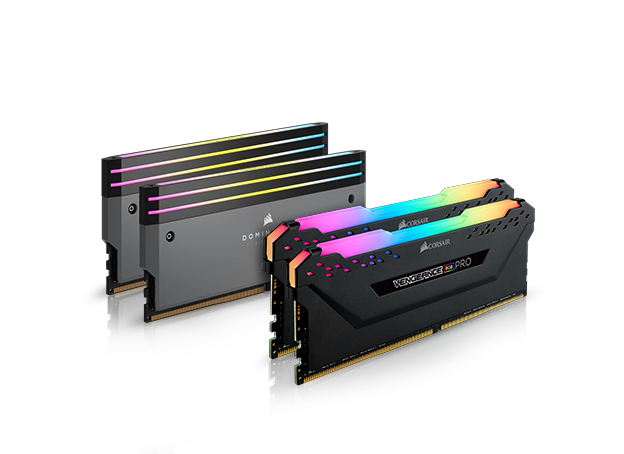
The RAM in a high-end PC should have a high clock speed and low latency to avoid becoming a bottleneck even when overclocked and to reliably support the processor. Many well-known memory manufacturers therefore offer specialized memory solutions for high-end PCs in their portfolios that are far superior to standard computer RAM. They feature hand-selected chips, specialized heat sinks, and even predefined profiles with the correct BIOS settings for overclocking. Memory modules such as the Corsair Vengeance LPX or Corsair Dominator Platinum RGB are definitely preferable to standard memory for a high-end PC.
For a high-end PC, at least 32GB of RAM is recommended, in the form of 2x 16GB DDR5-6000 (or higher) modules for dual-channel. Although 16GB of RAM is still sufficient for most eSports games, a larger capacity is often advisable or even essential for other professional applications or demanding games. In particular, for RAW video editing or professional image editing with Photoshop files that are several gigabytes in size, 32GB or even more RAM is usually required. Thanks to Double Capacity RAM, 96GB of RAM is now also possible on mainstream motherboards (Z890/X870), and on the WRX80, up to one terabyte is already achievable. |
|
High-End PC Memory
The RAM in a high-end PC should have a high clock speed and low latency to avoid becoming a bottleneck even when overclocked and to reliably support the processor. Many well-known memory manufacturers therefore offer specialized memory solutions for high-end PCs in their portfolios that are far superior to standard computer RAM. They feature hand-selected chips, specialized heat sinks, and even predefined profiles with the correct BIOS settings for overclocking. Memory modules such as the Corsair Vengeance LPX or Corsair Dominator Platinum RGB are definitely preferable to standard memory for a high-end PC.
For a high-end PC, at least 32GB of RAM is recommended, in the form of 2x 16GB DDR5-6000 (or higher) modules for dual-channel. Although 16GB of RAM is still sufficient for most eSports games, a larger capacity is often advisable or even essential for other professional applications or demanding games. In particular, for RAW video editing or professional image editing with Photoshop files that are several gigabytes in size, 32GB or even more RAM is usually required. Thanks to Double Capacity RAM, 96GB of RAM is now also possible on mainstream motherboards (Z890/X870), and on the WRX80, up to one terabyte is already achievable. |
 | High-End PC Motherboard
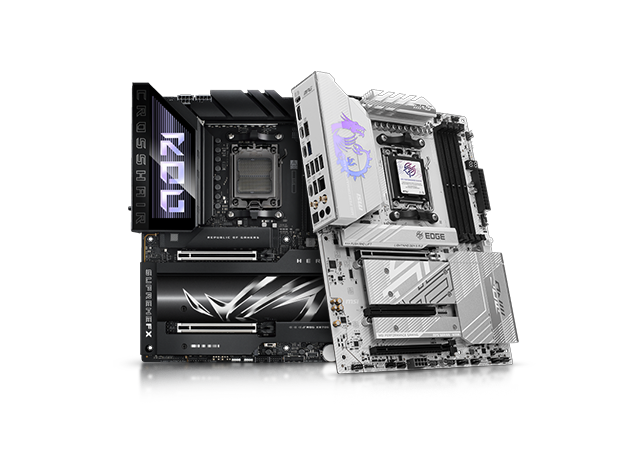
The motherboard connects all the components of a high-end PC and should therefore be chosen carefully to ensure that each component can perform at its full potential. Only high-quality, battle-tested motherboards are suitable for a high-end PC. A high-end motherboard should feature the latest chipset; for our Raptor Lake systems, this is the new Z890 chipset, for Ryzen the X870 chipset, and for Threadripper processors the WRX80. A “must-have” for high-end motherboards is a robust power supply for the processor as well as a well-designed chipset cooling solution to ensure stable operation even under sustained full load and to achieve the best possible overclocking results. To use NVLINK technology, a motherboard with at least 2x 16x PCI-Express 4.0 slots is required so that 2 or more graphics cards can be installed.
Motherboard manufacturers ASUS and MSI have made it their mission to continually delight gamers and professional users with exciting innovations in the motherboard sector. Fine-tuning options and customization features allow users to get even more out of their high-end PC systems. |
|
High-End PC Motherboard
The motherboard connects all the components of a high-end PC and should therefore be chosen carefully to ensure that each component can perform at its full potential. Only high-quality, battle-tested motherboards are suitable for a high-end PC. A high-end motherboard should feature the latest chipset; for our Raptor Lake systems, this is the new Z890 chipset, for Ryzen the X870 chipset, and for Threadripper processors the WRX80. A “must-have” for high-end motherboards is a robust power supply for the processor as well as a well-designed chipset cooling solution to ensure stable operation even under sustained full load and to achieve the best possible overclocking results. To use NVLINK technology, a motherboard with at least 2x 16x PCI-Express 4.0 slots is required so that 2 or more graphics cards can be installed.
Motherboard manufacturers ASUS and MSI have made it their mission to continually delight gamers and professional users with exciting innovations in the motherboard sector. Fine-tuning options and customization features allow users to get even more out of their high-end PC systems. Exclusive ASUS features such as TweakIt, ProbeIt, Extreme Engine, CPU Level Up, iROG, Extreme Tweaker, BIOS Flashback, Loadline Calibration, AI Gear, AI Booster, and other technologies are sure to make overclockers’ hearts race. Designed with gaming in mind, these motherboards are ideal for any high-end PC, thanks to their exceptional quality and stability. |
 | High-End PC Power Supply
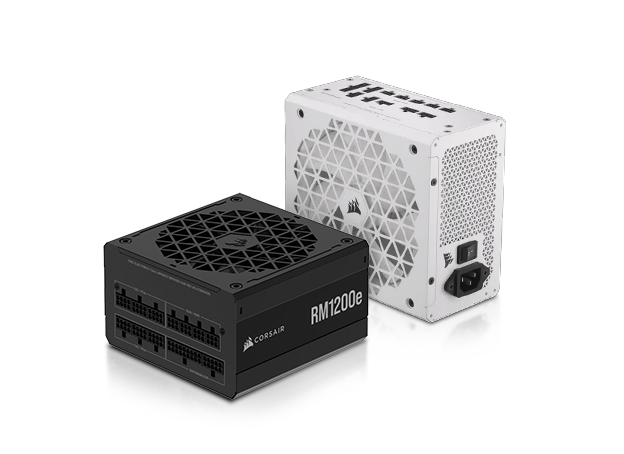
To ensure a stable power supply for your overclocked high-end PC, we recommend a reliable and powerful power supply. On average, 700 watts is the minimum requirement. For high-end PC systems with multiple graphics cards, 1000 watts or more is not uncommon. In this case, the rule "Better too much than too little" applies. A modern high-end power supply should have 80 Plus certification, ideally 80 Plus Platinum, a quiet and regulated fan, advanced safety circuits, multiple PCI Express power connectors for the graphics card or cards, and proper cable management. However, not all products meet these standards. By using low-quality capacitors and other components, some power supply manufacturers fall short from the start. Highly recommended options include models from Germany’s leading power supply manufacturer, be quiet!, such as the Dark Power Pro and Straight Power series, as well as Corsair’s RMx and HX models.
|
|
High-End PC Power Supply
To ensure a stable power supply for your overclocked high-end PC, we recommend a reliable and powerful power supply. On average, 700 watts is the minimum requirement. For high-end PC systems with multiple graphics cards, 1000 watts or more is not uncommon. In this case, the rule "Better too much than too little" applies. A modern high-end power supply should have 80 Plus certification, ideally 80 Plus Platinum, a quiet and regulated fan, advanced safety circuits, multiple PCI Express power connectors for the graphics card or cards, and proper cable management. However, not all products meet these standards. By using low-quality capacitors and other components, some power supply manufacturers fall short from the start. Highly recommended options include models from Germany’s leading power supply manufacturer, be quiet!, such as the Dark Power Pro and Straight Power series, as well as Corsair’s RMx and HX models.
|
 | High-End PC Cases
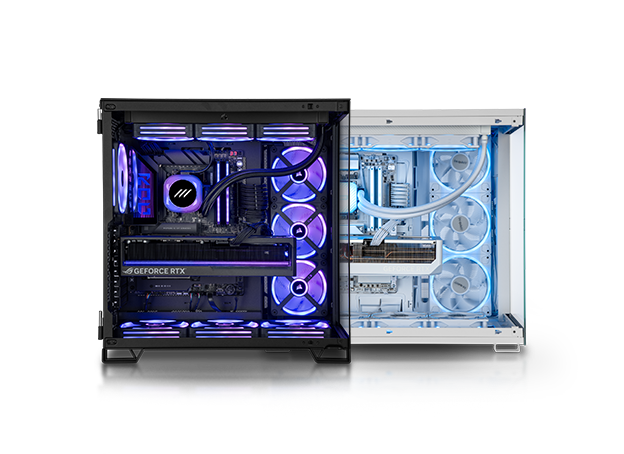
For a high-end PC, the case should primarily offer sufficient space for particularly bulky graphics cards with large cooler designs, a large power supply, and, of course, effective cooling for the hot components inside. For a high-end PC, we therefore recommend mid-tower cases with ample space and numerous fan mounting options, such as the Lian Li PC-O11 Dynamic, as well as big-tower cases like the Fractal Design 7 XL or Corsair 7000D Airflow.
In addition, many seemingly unimportant additional features should not be overlooked in a high-end PC case. These include well-designed cable management, which allows both the routed and unused power supply cables to be elegantly hidden behind the rear panel of the case. Furthermore, a high-end PC case should offer sufficient space for installing large CPU coolers such as the Noctua D15 or for installing radiators, such as the triple radiator in the Corsair Titan RX 360 RGB compact liquid cooling system. |
|
High-End PC Cases
For a high-end PC, the case should primarily offer sufficient space for particularly bulky graphics cards with large cooler designs, a large power supply, and, of course, effective cooling for the hot components inside. For a high-end PC, we therefore recommend mid-tower cases with ample space and numerous fan mounting options, such as the Lian Li PC-O11 Dynamic, as well as big-tower cases like the Fractal Design 7 XL or Corsair 7000D Airflow.
In addition, many seemingly unimportant additional features should not be overlooked in a high-end PC case. These include well-designed cable management, which allows both the routed and unused power supply cables to be elegantly hidden behind the rear panel of the case. Furthermore, a high-end PC case should offer sufficient space for installing large CPU coolers such as the Noctua D15 or for installing radiators, such as the triple radiator in the Corsair Titan RX 360 RGB compact liquid cooling system. |
High-End PCs – Customized. Powerful. Unique.
Build your own custom high-end PC with the MIFCOM configurator. Choose from powerful Intel or AMD processors, high-end graphics cards like the NVIDIA RTX series, fast SSD and RAM, and innovative cooling systems. This way, you’ll get a system that’s perfectly tailored for gaming, streaming, or professional applications.
High-End PCs – Customized. Powerful. Unique.
Build your own custom high-end PC with the MIFCOM configurator. Choose from powerful Intel or AMD processors, high-end graphics cards like the NVIDIA RTX series, fast SSD and RAM, and innovative cooling systems. This way, you’ll get a system that’s perfectly tailored for gaming, streaming, or professional applications.
High-End PC Costs and Prices:
The cost of a high-end PC starts at around €2,500 and has no upper limit. A fully equipped
high-performance PC can easily cost €3,000 or more.
Applications for High-End Computer Systems
 Ultra HD gaming
HD video editing
3D applications
Rendering
Simulation
Other professional & particularly computationally intensive applications
Your MIFCOM Team
High-End PC Costs and Prices:
The cost of a high-end PC starts at around €2,500 and has no upper limit. A fully equipped
high-performance PC can easily cost €3,000 or more.
Applications for High-End Computer Systems
Ultra HD gaming
HD video editing
3D applications
Rendering
Simulation
Other professional & particularly computationally intensive applications
Your MIFCOM Team